Work Slop: Why Your Employees Produce AI Garbage and What That Reveals About Your Leadership
41% of employees produce AI garbage. The solution isn't in processes, but in the psychology behind it. Recognize and respond to three coping patterns.
$186 per employee. Per month. Lost.
That's the number researchers from BetterUp Labs and Stanford University published in September 2025 when they investigated the phenomenon of "work slop." They surveyed 1,150 office workers in the U.S. and found: 41% had received AI-generated garbage from colleagues in the past month. Per incident, recipients lost nearly two hours of work time trying to decipher, correct, or completely redo the material (Niederhoffer et al., 2025).
For a company with 10,000 employees, that's $9 million per year. Burned.
Harvard Business Review called it "work slop." MIT published a report the same summer suggesting that up to 95% of companies see no measurable ROI on their AI investments (Challapally, 2025). The report's methodology is disputed, the direction is not: Investments are rising, results remain elusive. The diagnosis is correct. What Forbes, HBR, and most consultants propose as solutions (quality standards, review processes, "best practices") falls short. It treats the symptom and ignores the cause.
Work slop isn't a technology problem. It's not a process problem. It's a stress signal.
What's Happening Beneath the Surface
Richard Lazarus and Susan Folkman formulated the Transactional Model of Stress in 1984. The core message: Stress doesn't arise from a situation. Stress arises when a person appraises demands as higher than their available resources (Lazarus & Folkman, 1984).
The word "appraises" is crucial.
It's not about the objective difficulty of a task. Two employees on the same team, with the same task, the same deadline, react completely differently. One delivers. The other delivers work slop. The difference lies in the subjective appraisal of the situation.
A clinical study by Obbarius et al. (2021) confirmed this model with 2,216 psychosomatic patients: The stress response is more strongly predicted by a person's perceived resources (β = -0.73) than by the perceived stressors themselves (β = 0.34). The sample doesn't come from a work context, but the mechanism is the same: Perceived resources explain the stress response almost twice as strongly as perceived demands.
For you as a leader, this means: When your employee produces work slop, it says less about the AI tools and more about their internal state.
The Three Faces of Work Slop
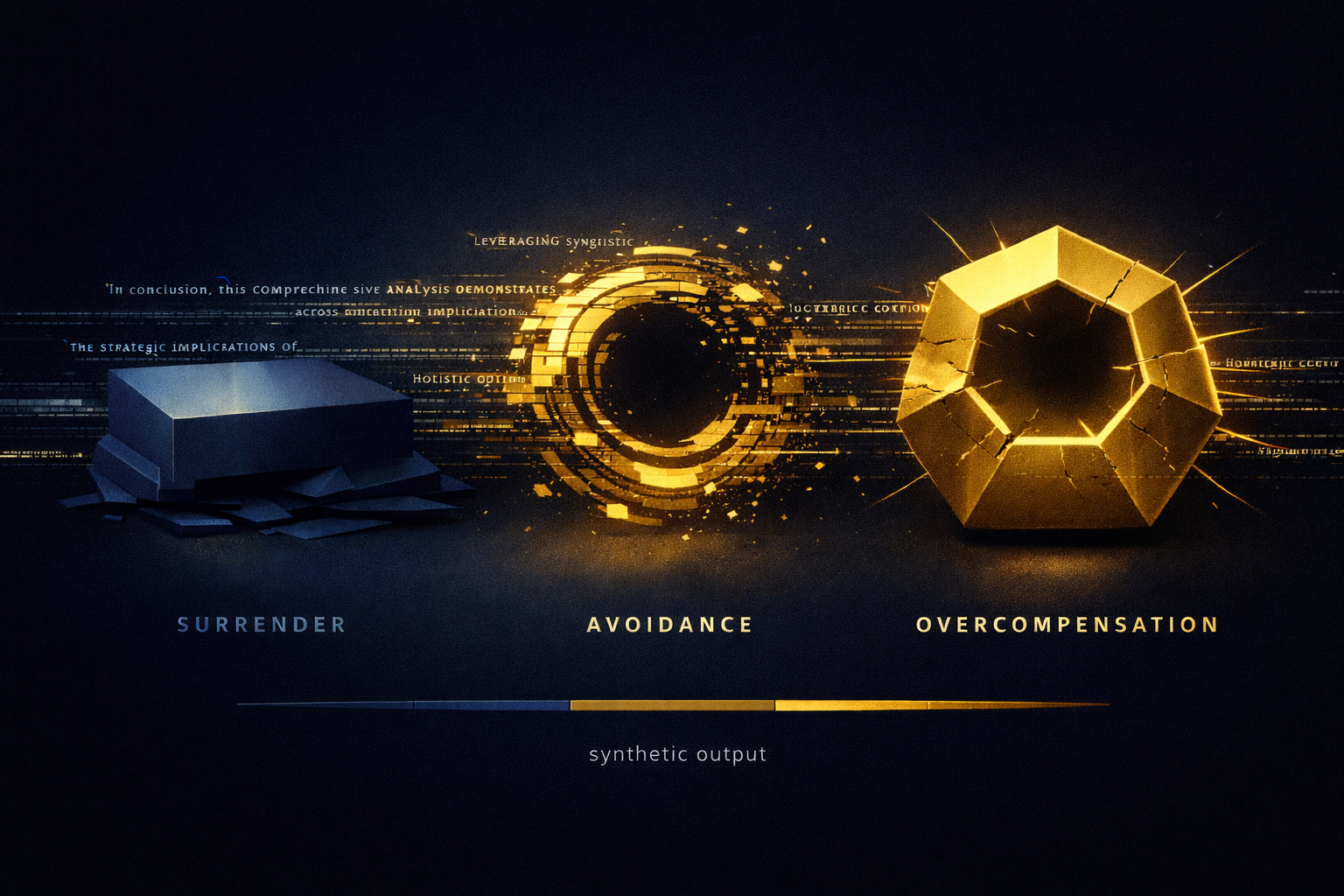
Jeffrey Young, founder of schema therapy, identified three fundamental coping modes that people activate under stress: Surrender, Avoidance, and Overcompensation (Young, Klosko & Weishaar, 2003). Lazarus and Folkman already described coping strategies in their stress model. Young goes a step further: His modes don't describe situational reactions, but entrenched patterns that have built up over years and are automatically activated under stress. For the work context, this is more relevant because work slop isn't a one-time event, but a recurring behavioral pattern. And these three patterns show up in every department where work slop emerges.
Pattern 1: Surrender
"The AI knows better than I do." This employee gives up control. Takes the AI output, glances over it briefly, sends it on. The internal conviction: "I'm too slow. I don't understand this fast enough." Young calls this "Compliant Surrender": The person accepts the negative self-image as truth and acts accordingly (Young et al., 2003). This isn't laziness. This is capitulation to one's own sense of inadequacy.
Recognition signs: Fast delivery. Fluent text. Substantively empty. When questioned: Uncertainty or defensiveness.
Pattern 2: Avoidance
"Done. Next task." This employee wants to get rid of the task. Not because it's unimportant, but because it triggers an uncomfortable feeling. AI is the perfect avoidance tool: It produces something that looks like work in seconds. Young describes the "Detached Protector": The person cuts the emotional connection to the task to protect themselves from the stress feeling (Young et al., 2003).
Recognition signs: On-time delivery, fluctuating quality. Strong on tasks that feel comfortable. Weak on everything that stresses.
Pattern 3: Overcompensation
"Look how productive I am." Quantity over quality. Ten slides instead of three. Five pages of analysis instead of a clear recommendation. Or, in the destructive variant: deliberately mediocre output as passive resistance. "If you want me to use AI, you'll get AI quality." Young calls it the "Overcompensator": The person fights against the feeling of helplessness by oversteering in the opposite direction (Young et al., 2003).
Recognition signs: Volume without substance. Or: demonstrative AI use with constant reference to "doing everything with AI, as requested."
Why Processes Don't Solve the Problem
The standard answer to work slop is: Policies. Quality gates. Review cycles. Training on proper prompt engineering.
That sounds reasonable. It works on the surface. And it's itself a form of avoidance.
When you as a leader create a process document that regulates how employees should check AI output, you've circumvented the actual problem: You would have to talk to your employees about their stress experience. Processes regulate output. They don't regulate the internal state that produces the output. The difference from behavioral change in leadership: When you ask differently and respond differently, you change the employee's appraisal of the situation. You reduce the perceived stress at the source, instead of regulating the symptom.
A study by Wu et al. (2025) in Scientific Reports reveals another blind spot: In four experiments with 3,562 participants, researchers found that AI use increases immediate task quality, but triggers significantly less intrinsic motivation and more boredom on the next task without AI. The data suggest that AI use changes the emotional experience of work. More processes don't solve that.
The Cascade Nobody Sees
This is where it gets personal for you as a leader.
You observe work slop in your team. The mediocre presentations, the hollow reports, the bloated emails. And the moment you interpret this as your own leadership failure, stress arises in you. Your perceived demands ("I have to solve this") exceed your perceived resources ("I don't know how to address this psychologically"). Then you activate the same three patterns.
You surrender: "That's just how it is with AI. You have to accept lower quality."
You avoid: You ignore the problem or delegate to HR: "Organize an AI training."
You overcompensate: You micromanage, personally check every output, burn your own time, and signal to the team: "I don't trust you."
Lazarus and Folkman described exactly this dynamic: When the stress response sets in, it continuously influences the appraisal of the situation (Lazarus & Folkman, 1984). The stress reinforces itself. The pattern propagates from top to bottom through the organization.
What Works Instead
The solution doesn't begin with AI. It doesn't begin with processes. It begins with a question you ask yourself: "What does my employee feel when they receive this task?"
Recognize Perceived Stress
Work slop is a behavioral signal. It says: "This person is currently overwhelmed, and they don't know how to communicate it." Your job as a leader isn't to correct the output. Your job is to see the person behind it.
This doesn't mean going soft. It means becoming precise.
Don't ask: "Why is this so bad?" Ask: "What do you need to complete this task in a way you can stand behind?" The difference sounds subtle. It's fundamental. The first question activates defense. The second activates reflection.
Neither Too Soft Nor Too Hard
Most leaders oscillate between two extremes: They ignore the work slop (too soft) or they sharply criticize the output (too hard). Both intensify the employee's stress.
The middle way: Clarity without judgment. "This document doesn't serve its purpose. Let's look together at what was missing." You name the problem. You offer support. You don't let the person off the hook, and you don't push them down either.
Activate the Curious Child Mode
Your employees face the task of redefining their role: away from executing (creating Excel spreadsheets, writing texts, compiling data) toward conducting (delegating to AI, evaluating, asking the right questions). This transition feels like loss of control. And loss of control activates stress.
Concretely: Give an employee struggling with AI output one hour per week for free experimentation. No results obligation. No evaluation. Just the question: "What did you try and what surprised you?" You signal: Learning is welcome, failure during experimentation is allowed. The fear of irrelevance must be addressed before it manifests as work slop.
Recognize Stress Before It Shows as Work Slop
If you wait until the mediocre output lands on your desk, you're too late. The stress response was there weeks earlier.
Watch for three warning signs: The employee who suddenly asks fewer questions than before. The employee who says "all clear" when you ask about status, without delivering details. The employee who changes their work hours (suddenly much earlier or much later). These behavioral changes precede work slop.
What do you do then? In most cases, a direct conversation suffices: "I notice you're withdrawing. What do you need?" In other cases, professional support from a psychotherapist is necessary. Both options require you to read the signals. The competence to recognize psychological stress in employees and respond appropriately can be trained. Our Mental Health First Aid course for leaders teaches exactly that.
The Uncomfortable Truth
Not every mediocre output is a stress signal. Some tasks are poorly defined. Some processes are so bureaucratic that even motivated employees take the path of least resistance. And the 95% figure from the MIT-NANDA report is methodologically disputed. Monocausal explanations are rarely correct.
But when work slop occurs frequently in your team, when quality drops across the board, when your best people suddenly deliver average work, then it's worth looking beneath the surface. Then it's not about processes. Then it's about people.
Work slop disappears when leaders understand that this stress is subjective. And that subjectivity isn't a defect to be rationalized away with policies.
The next question you ask yourself determines what happens: Are you looking at the output or at the person who produced it?
AI readiness doesn't begin with tool training. It begins with the question of whether your organization is psychologically ready for the change that's happening.
References with URLs:
Niederhoffer, K., Rosen Kellerman, G., Lee, A., Liebscher, A., Rapuano, K. & Hancock, J. T. (2025). AI-Generated "Workslop" Is Destroying Productivity. Harvard Business Review, September 2025. https://hbr.org/2025/09/ai-generated-workslop-is-destroying-productivity
Challapally, A. (2025). The GenAI Divide: State of AI in Business 2025. MIT Media Lab / Project NANDA, July 2025. https://www.artificialintelligence-news.com/wp-content/uploads/2025/08/ai_report_2025.pdf
Lazarus, R. S. & Folkman, S. (1984). Stress, Appraisal, and Coping. New York: Springer Publishing Company.
Obbarius, N., Fischer, F., Obbarius, A., Nolte, S., Liegl, G. & Rose, M. (2021). A Modified Version of the Transactional Stress Concept According to Lazarus and Folkman Was Confirmed in a Psychosomatic Inpatient Sample. Frontiers in Psychology, 12, 584333. https://www.frontiersin.org/journals/psychology/articles/10.3389/fpsyg.2021.584333/full
Young, J. E., Klosko, J. S. & Weishaar, M. E. (2003). Schema Therapy: A Practitioner's Guide. New York: Guilford Press.
Wu, S., Liu, Y., Ruan, M., Chen, S. & Xie, X.-Y. (2025). Human-generative AI collaboration enhances task performance but undermines human's intrinsic motivation. Scientific Reports, 15, Article 15105. https://www.nature.com/articles/s41598-025-98385-2
Discover more insights about AI Readiness Program
Related Articles
Agent Readability: Why Your Business Is Invisible to AI Agents
McKinsey projects $1 trillion in AI agent-mediated retail by 2030. 51% of internet traffic is already automated. If agents can't find you, customers won't either.
Fear of Productivity: Why Companies Use AI to Shrink Instead of Grow
Most companies use AI to cut costs. That is the most expensive form of avoidance. Same workforce, 10x productivity would be the right equation.
We Learn Distrust and Unlearn Trust
Trust is the default state. Distrust is learned. Why control is an illusion and what it means for your leadership.