I Forgot. And That's a Good Thing.
Organizational forgetting is not a sign of weakness. It proves your company has a functioning AI memory architecture.
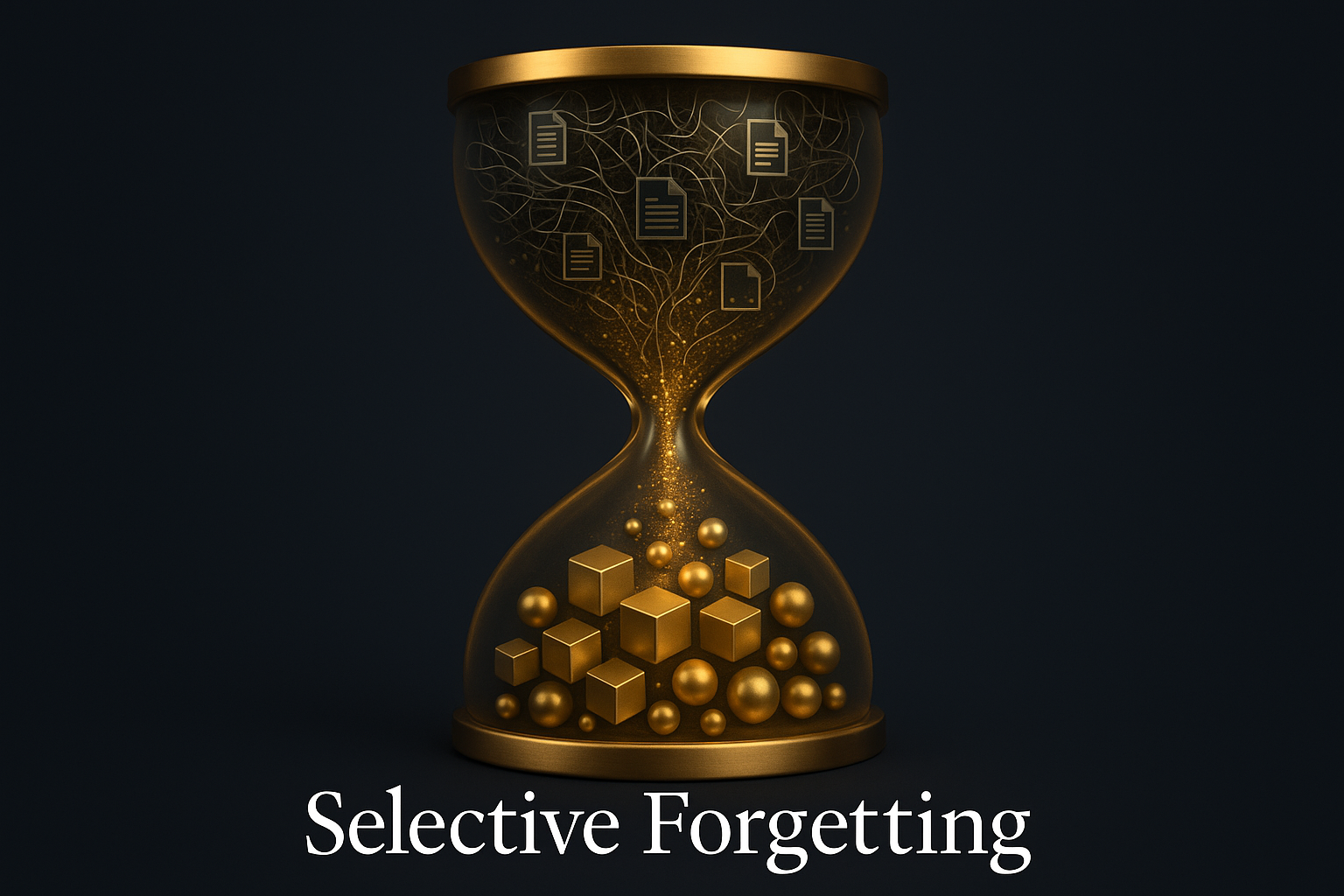
Your company should have systems that forget. Not because forgetting is convenient. Because forgetting proves your organization has what matters in the AI revolution: a functioning, selective memory architecture.
Sounds provocative? Good. Let me explain why companies that store everything know nothing.
Your Brain Doesn't Forget by Accident
The human brain is not an archive. It is a prioritization system.
Every night while you sleep, a process runs that neuroscientists call synaptic pruning: synapses that were weakly used during the day get weakened or eliminated. Synapses that were strongly activated get reinforced. Langille described in 2019 in Frontiers in Cellular Neuroscience that sleep serves two simultaneous functions: consolidation of relevant memory content and adaptive forgetting of irrelevant content (1). Not despite each other. Simultaneously.
The hippocampus, responsible for memory formation, does something elegant: it actively forgets. Malleret and colleagues showed that inhibiting long-term depression, the neurobiological mechanism of forgetting, does not lead to better memory. It leads to cognitive overload (2). The brain needs forgetting to learn.
Without selective forgetting, no signal. Only noise.
Your brain knows this. Your company probably does not.
What Happens When Organizations Keep Everything
Speier, Valacich, and Vessey showed back in 1999 that decision quality drops once the volume of information exceeds processing capacity (3). This is not a new finding. But what is new: the amount of available information has not doubled since then. It has grown exponentially.
And the response from most organizations? More tools. More databases. More Slack channels. More stored documents. More context that no system makes truly accessible.
Hwang and Lin analyzed 31 experiments in a 1999 meta-analysis on the effects of information diversity on decision quality (4). Their finding: both excessive and redundant information degrades decisions. Not slightly. Significantly.
The paradox: the more your company stores without prioritizing, the worse the decisions become for those who depend on that information.
You are not building a knowledge base. You are building a digital attic.
Why Now? Because AI Agents Force the Forgetting.
Until recently, unstructured information hoarding was expensive but tolerable. Humans navigated through the data clutter. Not well. But somehow.
That is changing fundamentally right now.
AI agents do not work like humans. They do not browse folder structures. They do not interpret contexts that were never made explicit. A language model accessing your company data in a poorly structured system does not find decision-making foundations. It finds noise.
Here is the critical point: to build AI-accessible memory, you are forced to decide what gets stored and what does not. What gets indexed with semantic embeddings. What gets prioritized.
You have to learn to forget.
This sounds like a technical problem. It is a psychological one.
The Psychological Pattern Behind the Hoarding
Why do organizations store everything? Not for rational reasons.
They store everything for the same reason executives delay important decisions: fear of forgetting something important. Fear of losing something that later turns out to be critical. Fear of the consequences of wrong prioritization.
This is experiential avoidance at an organizational level. Hayes and colleagues defined this pattern in 1996 as the attempt to avoid unpleasant internal experiences, even when that avoidance causes long-term damage (5).
In the individual, it looks like this: the CEO who delays critical personnel decisions because confrontation feels uncomfortable.
In the organization, it looks like this: the company that stores everything because engaging with the question "What is truly important?" feels uncomfortable.
That question is unpleasant. It forces prioritizations that make visible what was never clear before. It makes explicit what is strategically real and what is merely being managed.
As long as everything is stored equally, nobody has to decide. That feels safer. It costs more.
What Selective Forgetting Reveals About Your Organization
If your company is able to selectively forget, it proves three things.
First: you have decided what matters. This sounds trivial. It is radical. Most organizations have no explicit answer to the question "Which knowledge is strategic?" They have answers to "How do we file this?" Not the same thing.
Second: your systems are AI-accessible. To prioritize and filter meaningfully, you need a structure that captures significance, not one that merely stores documents. That is the technical core. Not because technology is the goal, but because structure makes priority visible.
Third: your leadership has overcome the fear of forgetting. That is the psychological prerequisite. Organizations that keep everything have leaders who avoid prioritization decisions. Organizations that selectively forget have leaders who have decided who they are.
The Difference That Matters in the AI Revolution
Two companies. Same industry. Same headcount.
Company A has 15 years of documents in SharePoint, Slack channels for every occasion, and an IT strategy built around "save everything." AI tools get introduced, but nobody connects them meaningfully with company knowledge. Every AI prompt starts by building context the system does not have.
Company B has decided what belongs in an AI-accessible system. Decisions are captured in structured formats. Context is made explicit. The irrelevant is actively not retained. Every AI agent accessing this system does not start from zero. It starts with six months of accumulated, structured context.
The advantage compounds. Every captured decision makes the next query more precise. Every explicit prioritization improves the signal-to-noise ratio. The system does not get bigger. It gets smarter.
This is not a technology project. It is a leadership decision.
What This Means for You
The question is not whether your company adopts AI. The question is whether your company is capable of making decisions before AI agents mirror the decisions your systems never made explicit.
Forgetting is not loss. It is consolidation. Exactly like the brain: it is not what gets forgotten that determines your performance. It is what gets strengthened because the irrelevant made room.
Your brain does this every night. Without fear. Because it learned that prioritization is not a threat. It is the prerequisite for every clear thought the next morning.
The next question you ask yourself determines what happens: are you avoiding the decision about what truly matters? Or are you starting to make it?
Sources with URLs:
Langille, J. J. (2019). Remembering to Forget: A Dual Role for Sleep Oscillations in Memory Consolidation and Forgetting. Frontiers in Cellular Neuroscience, 13, 71. https://doi.org/10.3389/fncel.2019.00071
Malleret, G., Alarcon, J. M., Martel, G., Takizawa, S., Vronskaya, S., Yin, D., et al. (2010). Bidirectional regulation of hippocampal long-term synaptic plasticity and its influence on opposing forms of memory. Journal of Neuroscience, 30(10), 3813-3825. https://www.jneurosci.org/content/30/10/3813
Speier, C., Valacich, J. S., & Vessey, I. (1999). The influence of task interruption on individual decision making: An information overload perspective. Decision Sciences, 30(2), 337-360. https://doi.org/10.1111/j.1540-5915.1999.tb01613.x
Hwang, M. I., & Lin, J. W. (1999). Information dimension, information overload and decision quality. Journal of Information Science, 25(3), 213-218. https://journals.sagepub.com/doi/10.1177/016555159902500305
Hayes, S. C., Wilson, K. G., Gifford, E. V., Follette, V. M., & Strosahl, K. (1996). Experiential Avoidance and Behavioral Disorders: A Functional Dimensional Approach to Diagnosis and Treatment. Journal of Consulting and Clinical Psychology, 64(6), 1152-1168. https://doi.org/10.1037/0022-006X.64.6.1152
Discover more insights about Executive Advisory
Related Articles
Agent Readability: Why Your Business Is Invisible to AI Agents
McKinsey projects $1 trillion in AI agent-mediated retail by 2030. 51% of internet traffic is already automated. If agents can't find you, customers won't either.
Fear of Productivity: Why Companies Use AI to Shrink Instead of Grow
Most companies use AI to cut costs. That is the most expensive form of avoidance. Same workforce, 10x productivity would be the right equation.
Blame Shifting as Leadership Strategy: Why Toxic Managers Get Promoted
56% work under toxic leaders. The problem isn't the people. It's incentive systems that reward results and ignore the path to get there.